7 Conversation Starters to Get Your Audience Talking

7 Conversation Starters to Get Your Audience Talking

7 Conversation Starters to Get Your Audience Talking

You can’t read anything about marketing these days without reading about engaging your customers. But what does that really mean?

Engaging means capturing someone’s attention – connecting – and having a conversation. Not easy to do on the internet, particularly when there are millions of other things clamoring for attention at the same time.

But, that doesn’t mean it’s impossible. It just means you need to try harder.

The thing is, your customers want to talk to you. They want to know what you think, and most importantly, they want to believe that you care what they think.

It’s not as hard as you might think. Here are 7 simple conversation starters to get your audience talking to you.

Express an Opinion about Industry News

You want to build authority within your industry or niche? One of the best ways to do that AND start a conversation with your followers is to express an opinion – particularly if it might be new or controversial. Of course, you should only do this if you can back up your opinion.

A good way to get started with this tactic is to follow relevant publishers and influencers in your industry. When you see them post a piece of news that’s relevant to your followers, read the article (or watch the video) and figure out what you can add to the conversation. Then share it – and make sure to include a call to action that encourages your followers to chime in with their own opinions.

Everybody has a story to tell – and when you’re speaking to an audience who all have something in common with you, then it’s easy to think of a topic that may inspire people to share their stories.

The key here is to share your own story and then ask your followers to share their best stories with you. For example, say you own a travel agency. You might tell a story of a trip you booked for yourself before you were a travel agent and how it went wrong. Then, you could ask your followers for their travel horror stories.

The benefit of this type of sharing is that it provides you with an opportunity to respond, express sympathy or amazement, and build a bond with potential customers online.

Get Recommendations

People might love to tell stories, but do you know what else they like? Giving advice and making recommendations! And asking them for recommendations is a great way to get them talking.

What kind of recommendations should you ask for? Ideally, they should be relevant to your product or service. For example, I’m a marketing guy. I might ask:

  • What are your favorite marketing podcasts?
  • What publications do you follow on Facebook and Twitter?
  • Which marketing technique is your favorite, and why?
  • What marketing apps would you recommend?

You get the idea. The key is not to stray too far from your brand and product. Instead, keep a tight focus and encourage your followers to share their experiences and recommendations with you and each other.

Are you appearing at a local street fair or charity event? Sharing your involvement is a great way to remind people that you stand for something other than making money – and to underscore your involvement in your community and industry.

Even if you’re not appearing at an event, there’s a benefit to letting your followers know what’s going on in your community. Giving a nod to other businesses or to local charities can help you build trust and earn the admiration of your followers. You can encourage conversation by asking questions like these:

Another option is to include an open call to action at the end, something like “We hope you’ll stop by and check out our booth! There’s a free gift in it for you!”

Get Recommendations

Whatever industry or niche you’re in, the chances are good that your followers have some DIY experiences that are relevant.

Asking about them is a great way to learn about potential customers and build a warm rapport with them by responding to what they share.

Ideally, a DIY project should be something that uses (or could use) your products.

However, it doesn’t have to be. The key is to find a way to make what you post relevant to your brand – and then stand back and let your followers do the rest.

Asking questions is one of the best ways to get your followers talking. It’s especially helpful to you if you can get them talking in a way that helps you to learn more about them – because that’s information you can use to create future content.

For example, if you’re targeting small business owners, you could ask questions like:

  • What’s your biggest challenge as a business owner?
  • What problem do you wish someone would solve for you?
  • What product or service has helped you the most?

The answers to these questions can help you write blog posts, create a social media strategy, or even develop new products that are ideal for your target audience.

Ask for Testimonials

You already know that reviews and testimonials are hugely important in the world of marketing. What better way to get some new testimonials to share on your site than to ask your customers to provide them on social media?

Not only will asking for opinions help you get some positive testimonials, it may also help you discover potential issues and nip them in the bud before they become big problems. You should be prepared for some surprises – but if you approach the request with the right mindset, this technique can help you learn a lot about your customers.

Look who’s talking…

The bottom line is that your audience wants to talk to you. They don’t read your blog or follow you on social media because they’re looking for a lecture. The key is to give them the encouragement they need to share their thoughts, experiences, and opinions with you – and then, to stand back and listen to what they say.


5 Foolproof Ways to Get Visitors BACK to Your Website

5 Foolproof Ways to Get Visitors BACK to Your Website

Attracting a visitor to your website once is good. It means that your marketing is strong enough – or your Google rank is high enough – that you stood out from the competition and snagged some traffic.

So what?

If you know anything at all about marketing, you know that it’s rare for a first-time visitor to a website to buy anything or even fill out a subscription form.

It’s what they do on their NEXT visit – and the one after that – that will determine whether you’ve gained a new customer.

Makes sense, but it never ceases to amaze me how many businesses don’t focus on repeat traffic. But, that’s about to change.

Here are 5 foolproof ways to get those first-time visitors BACK to your website so you can make some money.

Get Them to Opt In to Your Mailing List

I know, I just said it was asking a lot to get a first-time visitor to your site to subscribe to your mailing list. But I didn’t say it was impossible!

The key, of course, is to give them a compelling reason to subscribe. Here are some ways you can do that:

  1. Put your opt-in form above the fold. That way, they won’t need to scroll down to see it – and they’ll know what they’ll be getting if they decide to subscribe.
  2. Simplify your form. I get that it’s tempting to ask a new subscriber for extra information – but all you really need is their email address and maybe a first name if you want to personalize your emails. Anything else – whether it’s their phone number, mailing address, URL, or shoe size – is extra. You should think long and hard about adding fields to your form.
  3. Incentivize the opt-in. A compelling and useful lead magnet can do a lot to get someone to fill out that form.
  4. Write a killer headline and call to action. Instead of just “Subscribe to our newsletter,” try “Get new marketing tips every day” as a headline. And make the CTA just as exciting.

Once a potential customer’s on your mailing list, you can email them with reasons to come back to your website. Simple, right?

Get Them to Opt In to Your Mailing List

If people aren’t coming back to your website, it could be because they didn’t enjoy their experience the first time they visited. That means that prioritizing usability is one of the best ways to encourage repeat visits.

Some of the things to think about when it comes to usability are:

  • Your site’s loading time
  • Mobile responsiveness
  • Clear and easy-to-use menus
  • Text that’s broken up with white space, images, and formatting (sub headers, bullet points, numbers, etc.)
  • Working internal and external links that make it easy to find related content

If it’s been a while since you’ve evaluated the usability of your site, now’s a good time to do it to make sure that you’re not frustrating visitors and discouraging them from returning to your site in the future.

Are people finding what they expect to find on your site? If a customer comes to you because they’re searching for art supplies, for example, think about what you can offer them that will add value to the products you sell. Can you provide a video tutorial on painting technique? A link to the website of an artist who uses that product?

The idea is to make sure that the content on your site – whatever it is – is directly relevant to the people you most want to attract. If you’re selling Human Resources software, have blog posts about topics that are relevant to HR professionals.

Because it’s rare for first-time visitors to convert, it’s essential to have a way to connect with them again even if they don’t opt-in to your mailing list. That’s where re-targeting comes in.

As you probably know, re-targeting is a kind of advertising that targets individual visitors to your site based on their behavior when they’re there. For example, you can:


  • Display an ad for a product they viewed – or an alternative product.
  • Let them know about a new blog post on a similar topic to an older post they viewed.
  • Remind them of the lead magnet they passed up when they didn’t opt in.
  • Encourage them to complete the checkout process if they added items to their cart.
  • Re-targeting is something you can do on Google or on social media. Simply pick the actions you want to target and watch your conversion rate soar.

The final thing you can do is to make the content on your website solution-oriented. Most people who type a keyword into Google do so because they’re looking for answers. That means that if you want them to bookmark your site, you need to provide them with what they need.

Focusing on solutions can also help you improve your site’s rank for keywords in voice search. Given the increase in the use of “Ok Google” as well as virtual assistants like Siri, Alexa, and Cortana, it makes sense to think about the questions that searchers are likely to ask when looking for sites like yours. Then, you can optimize your useful content for those questions.

Your solutions may come in any format you choose. You might create a blog post with a response to one question or produce a video or even a short webinar for another. The key is to focus on the visitor’s needs instead of promoting your company or brand. There’ll be time enough for that later.

Visitors need an excuse to return to your site
All About AI Interaction And Its Pros And Cons

All About AI Interaction And Its Pros And Cons

What do you think of when you think of artificial intelligence?

If your thoughts veer to the ominous HAL in 2001: A Space Odyssey, you’re not alone. And yet, in my opinion it’s a mistake for small business owners to avoid investing at least a little bit of time and money in AI. It’s a trend that’s here to stay.

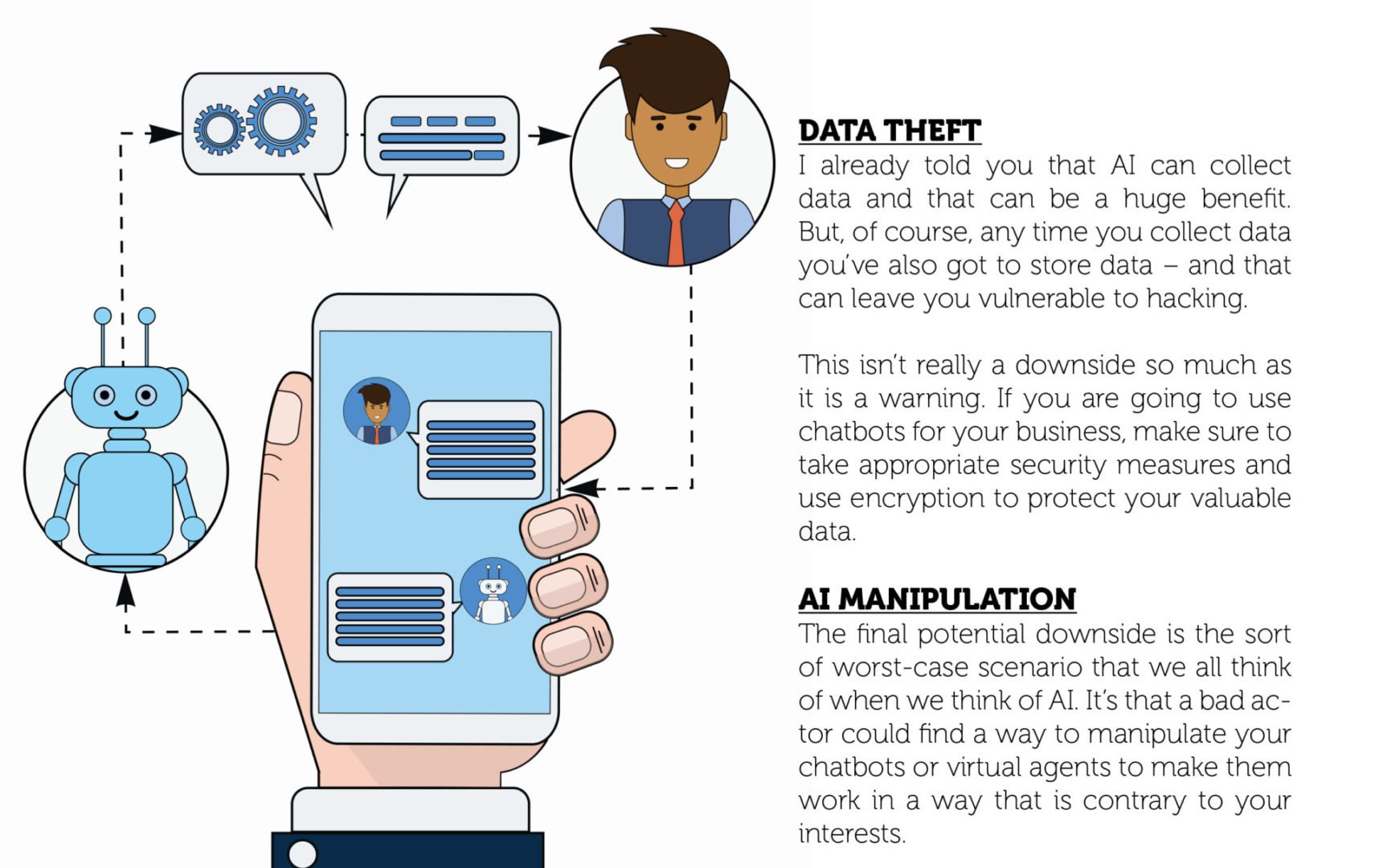
Now, that’s not to say that there aren’t some potential downsides to using AI. The most natural application of the technology for small business owners is a chatbot that can augment and improve your customer service. That means the bot would be interacting directly with your customers.

Scary? Maybe a little. But there are some serious benefits to using AI to go along with the risks. It’s important for you to understand both, so you can make an informed decision about whether AI is a worthwhile investment for your business.

The Pros of AI

Let’s start with the good news. Finding ways to have artificial intelligence interact directly with your customers can offer you some big rewards. Here’s what you need to know.

No Holidays or Time Off

The first plus of using AI for customer service is that AI isn’t human. That means it doesn’t need time off. It can be available to your customers around the clock, 365 days a year. If a customer needs help, your chatbot or virtual assistant can be there to offer it.

In the long run, you can save money on customer service because a chatbot can be programmed to handle a high volume of incoming requests and you won’t need to pay it a salary or benefits.

No Human Error

Another big benefit of incorporating AI into your customer service is that it can, if programmed properly, eliminate human error and make your customer interactions completely consistent across the board. That means no more flustered employees or inaccurate responses.

Even the best employee can be forgetful or have a bad day. A chatbot won’t have a bad day because they’re not programmed to have one. You can be sure that every customer who uses your chatbot will get the same professional, accurate information, every time.

Data Collection

Arguably the biggest positive associated with using artificial intelligence is that it can help you collect accurate and actionable data from your customers in real time. Since traditional customer research can take a huge amount of time, this is a huge plus and one that you can definitely use to your advantage.

You can learn which issues are causing trouble for your customers, which products they like the most, and at what times they’re most likely to buy from you. You can also use the data you collect to improve the programming of your chatbot and make your customer service even better than it already is.

Brand Personality

What’s your brand’s personality? Whether you’re formal or casual, funny or low-key, you can program your AI solutions with the language and personality that fits your brand. Since it can be difficult to screen employees and figure out how they’ll cope in a high-pressure situation, chatbot can be a good way to even things out.

The beauty of AI programming is that you can build variety and personality in with the right scriptwriters and programmers. You might not be able to imagine a chatbot with personality, but I also think you’ll be surprised by how much can be done with good programming.

These benefits are no joke. If you properly design and program your chatbot, they can help you elevate your customer service, build loyalty, and increase sales.

The Pros of AI

The pros are undeniable, but what are the downsides of having AI interact with your customers? There are several, and not surprisingly, they correlate with the pros I’ve already mentioned.

Round the Clock Monitoring

The first potential downside is related to the 24/7 nature of chatbots. A chatbot, even a well-programmed one, can’t handle ever potential customer problem. In fact, part of proper chatbot programming is making sure that the bot knows when and how to get human assistance.

Reading between the lines, then, there’s a need to have a human agent on call to back up the chatbot. That means that you’ll still need some human support and people who are willing to be on call even after hours.

Lack of Improvisation

Chatbot programming can do a lot – but it can’t do everything. In fact, one of the biggest downsides of using AI for customer service is that AI can’t improvise. It can only do what it’s been programmed to do.

In nine out of ten cases, that’s probably going to be fine. But what happens if a customer isn’t fluent in English or asks a question in a way that’s unfamiliar to the bot? You’ve got to be prepared for the likelihood that some customers, some of the time, will find dealing with a bot to be frustrating.

You’re not hiring HAL…

Using AI to interact with customers can do a great deal to help your business grow. The key is to put yourself in a position to reap the benefits while also protecting yourself from the potential downsides associated with AI.

How to Create a Killer Facebook Video Ad

How to Create a Killer Facebook Video Ad

Not using Facebook video for advertising?

I’m not going to beat around the bush. You’re making a mistake. In fact, I think Facebook video marketing may be the single best way to increase conversions and sales for your business.

That’s a bold statement, but I can back it up. People watch a huge amount of video on Facebook:

Facebook Video Ad

See what I mean? Just a few years ago, video marketing on Facebook was seen as cutting edge. Now, it’s the norm. If you’re not doing it, you are losing customers to your competitors. It’s just that simple.

How to Capture Your Audience with Video Advertising on Facebook

So, you know you need to be using video to appeal to your audience. What you may not know is that there are some specific qualities your video most have to work on Facebook. Here are some of the things your video should do if you want your campaign to be successful.

Grab the Viewer’s Attention Quickly

A recent Nielsen survey found that as much as 70% of an advertising video’s impact can be felt in the first 10 seconds. That means you’ve got only a limited time to grab your audience’s attention.

Video ads on Facebook play automatically in the feed – we’ll talk more about that later. That means that you have a unique opportunity to grab a viewer’s attention as they scroll past.

The key is to use powerful visuals right at the beginning of your video. You’ll need something that is visually engaging, surprising, and gets your point across quickly.

One example we like comes from Purple Mattress. This video features two Sumo wrestlers on top of a Purple mattress and it’s designed to demonstrate the strength of the mattress pad.

When you watch it, you’ll notice that the Sumo wrestlers appear at about 9 seconds. I think it might have been even more effective if they’d started with the Sumo wrestlers and then cut to the announcer. But as it is, the colorful video with its surprising visuals captured viewers’ attention.

To make the most of your Facebook marketing video, think of a strong visual story that demonstrates the uniqueness of your product. Then, introduce the story at the beginning of the video, ideally within the first 5 seconds.

Allow Viewers to Watch without Sound

The next thing your video must do is work without sound. Facebook videos in the feed play automatically, but viewers must opt to use sound. You can (and should) make it clear that they can click for sound, but your video should make its point even if a viewer doesn’t do that.

There are, of course, several ways that you can get by without sound:

  1. Create a video that’s all about visuals and doesn’t require any sound at all.
  2. Use bold titles and graphics on the screen.
  3. Include subtitles in your video.
  4. Create an animated video to tell your story.
  5. Add a “tap for sound” reminder on the screen.

Some people may be scrolling Facebook in a place where playing the sound on your video is not an option. The reason you want to make your video compelling without sound is to capture their attention.

Here’s an example we like from the website Tastemade, which features recipes, cooking advice, travel videos, and more. They created their Tiny Kitchen series to capture attention on Facebook – and they did it without any sound.

Here’s one video they created. It shows a human chef preparing food in a tiny kitchen. The only sound is incidental. With the hands there for scale, it grabs attention immediately and kept viewers watching all 13 minutes of the demo – showing that a Facebook video doesn’t need to be short to be compelling.

This was a Facebook Live video that grabbed more than 3.8 million view and was shared more than 17,000 times. Why? Because its surprising content and visually compelling style made people stop and pay attention.

Tell a Story

There’s plenty of evidence to show that stories are an effective form of marketing. Stories engage our brains by triggering an emotional response. An effective advertising story may be moving or humorous. It can be long or short.

One of the most effective things you can do is to find ways to tell a story that supports your brand’s personality and message. You don’t necessarily need a lot of time to do that, but you do need imagination.

Here’s an example I like from the company MeUndies. They claim to sell the most comfortable underwear in the world, but their story is not just about comfort. On their website, they say, “Finding underwear that makes you feel good is an easy way to boost your mood and your confidence.”

How do they get that across in a video? Check out this short video – it’s only 21 seconds long – that features a man wearing the company’s glow-in-the-dark Star Wars briefs to act out his fantasy of being Darth Vader:

This video gets is message across quickly. It uses a pop culture reference to one of the most successful film franchises of all time with a dash of humor as the man in the video realizes that his towel looks like Darth Vader’s helmet.

MeUndie’s Facebook video campaigns ultimately reached more than 1.4 million viewers and garnered them a 97% increase in incremental purchases.

capturing facebook audience
How To Avoid Getting Walloped By Google EAT Update

How To Avoid Getting Walloped By Google EAT Update

Has your organic traffic taken a nosedive lately – or if not a nosedive, at least a significant dip?

There’s a reason for that. Google tweaks its search algorithm all the time. Some updates are small and make only a small difference in search rankings. Others are major. And, that’s the case with the E.A.T. update, which caused some previously top-ranked sites to lose more than 50% of their organic traffic overnight.

Yikes.

If you’re familiar with Google’s methods, then you know that they hardly ever comment on updates or share relevant information about them. That means that marketers and SEOs have to guess what’s going on.

That can be tricky, but it turns out that this latest update can be summed up with three letters: EAT. Let’s talk about what they mean.

What Does E.A.T. Stand For?

Google’s E.A.T. algorithm has been given that name because of the three key things it prioritizes. They are:

  1. Expertise. How knowledgeable are you (or any contributing writers to your site) about the subject matter related to your business?
  2. Authoritativeness. How credible is your business in your industry or niche?
  3. Trustworthiness. Can readers trust the content you publish and trust you with their business?

Those three factors – expertise, authoritativeness, and trustworthiness – are things that loom large for consumers. Since Google prioritizes sites that are useful to searchers, it’s really not a surprise that they would find a way to reward sites that demonstrate them.

The trick, of course, is knowing what things Google’s looking at and what you can do to improve your results. Chasing organic traffic was already difficult. In fact, only about 9% of content gets any organic traffic from Google.

How to Demonstrate Your Expertise

The best way to demonstrate your expertise is to update and optimize your author biography and About Us pages. These pages give you the opportunity to let readers (and Google) know who you are and why you’re an expert.

You should have a biography page for every contributor to your blog. Their byline should link to their bio. The bio should include:

  • Education and degrees
  • Work experience
  • Professional certifications and accomplishments

In addition to formal awards and things of that nature, it’s also a good idea to share information about your social following if applicable. Anything that demonstrates that people turn to your authors for advice and information will help you with Google.

The same thing goes for your About Us page. On the page, you can still explain the usual things like how and why you started your business. In addition, make sure to mention:

  • The experts you’ve hired to be part of your team
  • Any industry awards or recognition your company has received
  • Anything that sets your business apart from your competitors

Using important keywords and linking to authoritative sources will help you highlight your expertise.

How to Demonstrate Your Expertise

The next element of E.A.T. is authority. Here are the most important things you can do to signal your authoritativeness to Google.

  1. Build backlinks to your site. Every SEO knows that backlinks are essential. When authority sites link back to your site, it tells Google that your site is an authority source of information in your industry or niche.
  2. Offer your services as an authority and do what you can to increase your visibility online. If you write a guest blog or speak at a conference, those things can add to your authority.
  3. Be a thought leader. Authority doesn’t come from following what others do. If you want to be seen as an authority, you must offer opinions and analysis without worrying about what other people are doing.

Establishing yourself as an authority figure will help to earn you a high place on Google’s SERP.

How to Demonstrate Your Trustworthiness

It’s a common saying that trust needs to be earned. That applies to marketing as much as it does to anything else. In other words, trust isn’t something you can wish into being. You must give people reasons to trust you.

Reputation management plays a big role in trust. When people review your company on sites like Yelp or Google My Business, what do they say about you? How do you handle negative reviews? Do you have quality testimonials on your site? Each of these things plays a role in establishing your reputation online.

The same is true of social mentions. It’s essential to keep track of when and how your business is mentioned on social media.

Finally, you can build trust by having proper security on your site. That means installing a security certificate and using encryption to protect your most important data.

Other Quick Fixes for E.A.T.

In addition to the things I’ve mentioned above, there are some other important steps you can take to make the most of Google’s latest update.

  • Evaluate your traffic and delete or redirect pages with low E.A.T. ratings.
  • Moderate user-generated content and be careful to label it accordingly, so it’s not mistaken as being representative of you or your company.
  • Make sure to present a consistent brand across all platforms. That may mean updating your social media profiles, re-writing content on your website, and re-doing paper marketing materials as well.
  • Create E.A.T.-friendly images, such as infographics and charts, to support the information on your website.

As you’re reworking or adding content, keep in mind that Google still prioritizes content that’s written for people, not machines. This isn’t about gaming the system or fooling Google.

Rather, you should be honoring the things that they have identified as important while also providing your readers with useful, valuable, and actionable content.

Google Update
Top 7 Marketing Trends You Cant Afford to Ignore

Top 7 Marketing Trends You Cant Afford to Ignore

Who cares about marketing trends, right?

If that’s your attitude, I get it. Some trends are here and gone before you even have time to figure out how to take advantage of them. It’s easy to dismiss trends as fleeting.

But the truth is… some aren’t fleeting. Some are here to stay. As the year ends and 2019 approaches, it’s a good time to take stock of your current marketing strategy. And, if you’ve been ignoring all trends in favor of the tried and true, then guess what? 2019 is the year to shake things up.

Now, I’m not saying that you need to jump on every trend as soon as you become aware of it. I am saying that I’ve noticed that a lot of small businesses aren’t taking advantage of the big trends – the ones that, for better or worse, aren’t going anywhere. And with that in mind, here are 7 trends that you can no longer afford to ignore in 2019.

1: Artificial Intelligence

I wrote about artificial intelligence last month, so you already know I think it’s important for small businesses to embrace this technology.

In marketing, the use of AI in the form of chatbots has taken root and many small businesses are adopting it. The bottom line is that a well-programmed chatbot can improve your customer service and increase sales.

AI is also becoming increasingly important in the field of marketing analytics. You can use it to make market predictions and get ahead of the curve as your audience’s preferences change and develop. And, let’s not forget that programmatic advertising – which uses AI to automate ad buying – is on the rise.

2: Personalization

One-size-fits-all marketing is rapidly becoming a thing of the past. While there’s still some benefit to targeting ads to a large audience, the trend increasingly is toward the kind of one-to-one marketing that Amazon has done brilliantly for years.

If every visitor to your website is seeing the same content, it’s time to think about how to personalize it. You can do that using cookies that make recommendations based on a user’s previous activity on your site. Or, you can allow users to choose the type of content that they want to see. Either way, the goal is to make every customer feel that you’re speaking directly to them.

Incidentally, the same trend should be applied to email marketing. Sending emails that are triggered by a customer’s behavior is three times more effective than sending batch emails – something to keep in mind in the new year.

3: Influencer Marketing

Ad blocking has been a challenge for marketers for years now, but the recent stats show that it’s now impacting mobile advertising as well as desktop. What can you do to get around it?

I’ve written about influencer marketing before, but it really has proven to be one of the best ways to engage with potential customers without needing to worry about ad blockers. It uses influential social media accounts that appeal to your audience.

It can take a bit of trial and error to find the right influencers but once you do, influencer marketing can be a cost-effective way of attracting new customers to your business.

4: Video Marketing

If you’re not making marketing videos to share with your audience, it’s time to stop pretending that video is too expensive (or too technical) to be worth your while. Research shows that businesses who use video marketing grow 49% faster than businesses that don’t. How can you ignore that?

The good news is that video doesn’t need to be expensive and you don’t need to be Spike Lee to make a terrific marketing video that will attract new customers. Even a simple Facebook Live session where you take questions from your followers can help you grow your business.

5: Social Messaging Apps

Did you know that every month, businesses exchange 2 billion (that’s with a B!) Facebook Messenger apps with their customers? That’s not just a trend – it’s a tsunami.

Using social messaging tools like Messenger or WhatsApp can help you connect with customers on a personal level. And – hearkening back to the first trend I mentioned – artificial intelligence can help you do it.

Creating a chatbot for Messenger or any other app is a relatively easy (and affordable) thing to do. A lot of companies use chatbots to suggest products or answer simple questions. That means that using messenger apps is an extremely effective way to connect with your existing audience and attract new potential buyers for your products and services.

6: Voice Search – smart speaker

If you’ve said “Okay Google” or asked Siri, Alexa, or Cortana to find something for you online, then you know that voice search is here to stay. In fact, researchers estimate that 50% of all searches will be voice searches by 2020 – and that means that it’s time to optimize your web content for voice search now.

You can start by using the language of voice search – optimizing for the terminology that your audience is most likely to use. You may also want to start thinking about audio-only ads. It’s probable that you’ll start hearing sponsored content on Alexa before long. This is an opportunity for you to beat out your competitors who may be lagging in this area.

7: Social Media Stories

If you’ve logged onto any social media account lately, you’ve probably noticed something: stories. Facebook may prompt you to add to your story, and other platforms – including YouTube – have jumped on the trend.

A social media story is temporary content that can be used to trigger your customers’ FOMO (that’s fear of missing out.) It’s ideal for seasonal promotions and deals, and it can be a great way to engage your audience. If you’re not already using social media stories to connect with your customers, 2019 is the year to start.

marketing trends typewriter storytelling
Why You Should Spend Money To Make Money

Why You Should Spend Money To Make Money

You’ve got to spend money to make money.

That’s what they say, right? And yet, for some small business owners, a generous marketing budget just isn’t in the cards.

You can skimp on marketing, but I’m willing to bet you haven’t considered something that you should be thinking about…

And that’s the lifetime value of each loyal customer you attract with your marketing campaigns.

You know that it costs more to attract a new customer than it does to retain an existing one – but how much can you really afford to spend to attract a new customer?

Knowing the lifetime value of your customers is the key to creating a workable budget for marketing. That number should dictate how much you spend. Spend too much and you’re losing money in the long run. Spend too little – and you’re missing out on an opportunity to grow your business.

How to Calculate Your Lifetime Customer Value

Don’t know how to calculate the lifetime value of your customers? Here’s a simple, five-step process to get to the number you need.
  1. Start with your company’s total revenue in the past year and divide it by the total number of purchases in the same period. The resulting number is your average purchase value.
  2. Next, take your total number of purchases in the past year and divide it by the number of unique customers who made purchases. The resulting number is your average purchase frequency rate. (Note: if you make a log of cash sales and don’t request an email, then this number may not be accurate.)
  3. Take your average purchase value and subtract the average purchase frequency rate from it. That gives you the customer value per year.
  4. Calculate the average number of years a customer continues to buy from you. If you’ve been tracking unique purchases this shouldn’t be difficult. This number is the average customer lifespan.
  5. Now, multiply the customer value by the average customer lifespan to get the lifetime value of your customer.
Let’s look at an example. Here are your raw numbers:
  • $100,000 in annual revenue
  • 250 purchases
  • 150 unique customers
Your average purchase value would be $400. You would then take that number and divide it by 150 to get your average purchase frequency rate, which is 2.67.

Next, you would subtract your average purchase frequency rate from your average purchase value to get $397.33, your customer value per year. If you keep your customers, on average, for 10 years, your customer lifetime value would be $3,973.30.

That’s a very simple example but it illustrates the point. This business has a lifetime customer value of nearly $4,000.

How to use Customer Lifetime Value in Marketing

You know your customer lifetime value – now what?

The short answer is that you’ve got a piece of information that can help you attract more customers and make better use of your marketing budget.

But… what does that mean in practical terms? Here are some actionable ways to use your CLV to your advantage in marketing.

Identify Your Most Profitable Customers

If you’ve been tracking unique customer data, then it’s worth your time to crunch the numbers and learn about who your most valuable customers are.

For example, you might look at your LCV by:

  • Age
  • Gender
  • Race
  • Location
  • Income
These basic demographics can help you do a better job of targeting your marketing campaigns to the people who are most likely to be profitable to you in the long run.

Identify Your Most Profitable Marketing Channel.

You should also calculate your most profitable marketing channel based on the number of new customers you acquire.

Perhaps you have been running marketing campaigns on:

  • Facebook
  • Instagram
  • Google AdWords
  • Pinterest
Crunching the numbers might reveal that your spending on Google AdWords is earning you a significantly lower return than your Facebook advertising. Knowing that can help you take the next step.

Increase Your New Customer Acquisition Spending

It costs more to attract new customers than to retain existing ones, but once you know your LCV, you may discover that your new customer acquisition spending is on the low side.

You don’t need to send your spending through the roof. However, you can and should look at what you’re spending compared to the LCV you’ve calculated. If you’re spending only a tiny fraction of the LCV to acquire a new customer, it may be worthwhile to spend a bit more in that area going forward.

Allocate Your Marketing Budget to Maximize Customer Value

Your lifetime customer value might not be as high as you want it to be. The good news is that there are things you can do to increase it.

For example, say that you have learned that the people who follow you on Facebook are your most engaged and profitable customers. That’s great information to have.

Instead of sinking money into something that might not be getting you a big return, you can allocate more of your marketing budget to Facebook. Some of it may go toward attracting new customers, but you should also spend some time trying to get existing customers to buy more frequently and spend more money.

One way to do that is to offer return customers discounts or to create a loyalty program. If you can inspire your existing customers to buy more often, then you’ll be driving up your LCV every time they do.

At the same time, incentivizing your existing customers may also attract new customers to your business. You can encourage your followers to invite their friends to your page or allow them to share a discount code or coupon with their friends.

Your Customers Are Valuable

Every customer you have contributes to your company’s success and profitability. Understanding just how much each customer is worth to you can help you do a better job of attracting new customers, increasing their lifetime value, and maximizing your profits.
Why You Should be Doing SMS Marketing Right Now

Why You Should be Doing SMS Marketing Right Now

What does your marketing mix include?

If you’re like most local businesses, you’re probably doing a mix of online and offline marketing. You might be engaging with customers on social media, hosting local events, blogging, and advertising in the local paper. Perhaps you’ve even targeted mobile customers by using Facebook’s “Call Now” button on your ads.

But guess what? There’s one thing that you’re probably not doing that could help you connect with customers when they’re most likely to engage with your business. And you might not even have considered it.

I’m talking about SMS messaging, more commonly known as text messaging.

More than 2.5 billion people worldwide own a smartphone that’s capable of text messaging.

That’s a staggering number – and it begs the question:

Why aren’t more small businesses using text messaging for marketing?

Texting by the Numbers

Text messaging has the potential to be a marketing superstar for your business. To get an idea of just how effective it can be, check out these statistics:

  • 89% of people always have their smartphone accessible
  • 97% of Americans text at least once a day
  • Texting is the #1 communication method used by people under 50 years old
  • 82% of text messages are read within 5 minutes of receipt

That last statistic is particularly important, especially when you consider that consumers open only about 25% of the emails they receive.

People send and receive text messages. They give them priority over other communication, and they spend more time texting than they do talking on their phones.

In other words, text messaging is arguably the best way to ensure that the people in your target audience read what you send them.

Advantages of SMS Marketing

You know people are likely to read your text messages – but what are the other advantages of incorporating text messages into your marketing mix? Here are five that I think are key:
  1. You can track SMS messages the same way you would any other marketing campaign using web-based tools like SlickText.
  2. You can collect data about your text list by creating interactive content that allows them to reply to your messages quickly and easily.
  3. Text messaging provides nearly instantaneous results and stats for you to use to fine-tune your campaigns.
  4. Text messaging can be casual and personalized with direct language and even emoji to build a relationship with the people you text.
  5. Text messages are a great way to connect with your audience when they’re most likely to be in your area or in the market for what you’re selling.
A good example of time-sensitive text messaging might be a restaurant or bar texting out a Happy Hour coupon at about the time most people are getting out of work. They might be planning to head out for a drink or a bite anyway, and you can provide them with a nudge to choose your establishment over others in the area.

How to Get Subscribers for Your SMS List

By law, you cannot send a text message to anyone who has not signed up for your list. That means that you must find ways to attract new subscribers. Here are some helpful suggestions to get started.

The first and potentially easiest way to find new subscribers is to add a mobile field to your existing opt-in form on your website. You can include a message letting people know that if they choose to provide you with a cell phone number, they’re agreeing to receive text messages from you.

Another option is to promote your SMS list in-store with large print posters, flyers and other print media encouraging your customers to sign up for exclusive discounts & offers. Make sure to mention what some of those exclusive offers might be.

You may also want to send out an email to your current email list and give your subscribers a link to sign up to receive text messages from you. Here again, it’s a good idea to tempt them by letting them know you’ll be sending out special coupons and deals via text message.

Using these methods, it shouldn’t take you very long to build up a sizable SMS messaging list.

Tips for Successful SMS Messaging Campaigns

Text message marketing has a lot in common with other forms of marketing. To be successful, you must conceptualize a strong campaign based on your knowledge of your subscribers, create compelling content, and track your results. Here are some tips that may help you.
Understand your audience. You may want to create a quick survey for your email list or social media followers to find out what kind of content they would like to receive via text message.

Keep your messages short and sweet. People are more likely to read your messages if they’re brief and compelling. A good rule of thumb is to make them about the same length as a Tweet – no more than 280 characters.

Offer mobile-exclusive deals to your subscribers. These might include exclusive coupons, discounts, and sales, especially for your mobile customers.

Use casual language that speaks directly to the recipient. Most important, use “you” and “your,” which underscore that the exclusivity of your list and make customers feel valued.

Don’t be afraid to bring some humor into your texts. It’s a casual form of communication and people like to laugh – but of course, keep it PG-rated and steer away from controversial topics.

Add a few emoji to your texts. People use them in their personal texts and they can add personality and fun to your marketing campaign.

Track your results and tweak your campaigns as needed.

Some text messaging providers try to include SlickText, SumoText, and SimpleTexting. You want a provider with affordable prices, an intuitive dashboard, and great analytics.

Conclusion

The bottom line is that if you’re not using SMS messaging to reach your audience, you’re missing out on a chance to build brand loyalty and increase your sales. Text messages are inexpensive to send and easy to write – and they can help you grow your business.
How Micro Moments Can Help You Attract New Customers

How Micro Moments Can Help You Attract New Customers

Right now, potential customers are online looking for your business. And you might be missing them.

Scary thought, isn’t it?

Let’s face it, there’s a ton of content out there. It can be hard to find what you’re searching for – and if the content you’re producing isn’t providing what the people in your target audience need when they need it, then they’re likely to end up with one of your competitors.

The answer? Understand the moments when customers pick up their phones to look for your business and craft content that gives it to them.

One way is to use what Google has coined Micro Moments, I.E. “the Customer Journey.” What are they and how can you use them to find new customers? Here’s what you need to know.

What is a Micro Moment?

Google coined the term Micro Moment to respond to what they saw as a growing trend. You already know that most consumers in the US are tethered to their smartphones 24 hours a day. But they’re more intensely engaged at some moments than at others.

A Micro Moment is a moment when a consumer is intent on finding something. They want a quick answer or solution. Google identifies them as:

In other words, a Micro Moment is a moment when a consumer is ripe to learn, experience, and buy things. It’s the ideal time to capture a new customer because they’re already in the right mindset to engage with your content.

There are some interesting statistics to back up the importance of Micro Moments. For example:

  • 91% of smart phone users look up information on their phones while they’re in the middle of a task
  • 82% of consumers consult their phones while they’re in a store – and of those, 20% buy something other than what they originally intended to buy
  • 69% of online consumers say that the quality, relevance, and timing of the content they find affects their opinion of a brand (and their purchase habits)
It’s clear that there’s a benefit to Micro Moment marketing. It’s about capturing the attention of people in your area who are seeking the products or services you’re selling. The trick, of course, is knowing how and when to capture your audience’s attention at those key moments.

What You Need for Micro Moment Marketing

Gathering information about customers is important for every business. You might have a small business with only one location, but you still need to understand who your customers are and how to use the data you collect to your advantage.

Some of the data to collect includes:

  • How your customers find your business and why they decided to buy from you
  • Where and how they prefer to make purchases
  • How they prefer to pay for their purchases
  • What things matter the most to them when making online purchases

For example, 53% of visitors will abandon a mobile site if it takes more than three seconds to load. That’s not much time – and if your site is slow, then you could be losing customers without realizing it.

You also need to understand how customers typically approach buying a product like yours. What information do they need? Where are they likely to go to get it? And – most importantly – how can you capitalize on their habits to draw them in?

Micro Moment Best Practices

There are some simple things you can do to engage your target audience in any one of more than 100 Micro Moments they experience each day.

Let’s start with Google’s definition of a Micro Moment. During a Micro Moment, customers want to know something, do something, go somewhere, or buy something. What that means is, in order to capture their attention, your business must:

  • Be there, meaning that you must have content that’s easily accessible and directly related to the information the people in your target audience want during a Micro Moment
  • Be useful, meaning that your Micro Moment content must provide a relevant digital experience that provides a potential customer with the information they want – and the means to act on it
  • Be accountable, meaning that you must provide a seamless customer experience that makes it easy for customers to buy from you across all channels
How to do all three? Well, here are some suggestions:
Conduct a customer survey using email or social media to get a better idea of the kind of content your customers need to buy from you.

Identify crucial points in your sales funnel, so you can capitalize on them. Here, I’m talking about the moment when a customer realizes that they need what you’re selling or that they have a problem that your product or service can solve.

Craft content that responds directly to those crucial points, providing customers with compelling content that’s both relevant and actionable.

Include in every piece of content a clear call to action that will direct your customer to your business or provide them with a phone number or a link to your website. (The key is to provide them with a way to take immediate action!)

Create your Micro Moment content and refine it until it’s giving you the return on investment that you need.

The most essential part of this process is knowing when your customers are likely to experience a Micro Moment. It might be when they’re making dinner plans or trying to get their kids ready to go back to school. The more information you have, the better able you will be to capture their attention and convert those Micro Moments into sales.

Micro Moments Are Fleeting

The human attention span might be shrinking, but that just means that you have new opportunities to engage with your customers in a way that’s most useful to them – and most profitable to you. Taking the time to understand Micro Moments can help you attract new customers at the point when they are most ready to buy from you.
5 Ways to Use Artificial Intelligence to Increase Your Sales

5 Ways to Use Artificial Intelligence to Increase Your Sales

The robots are coming for your business.

Okay, that might be a slight exaggeration, but the truth is that in recent years, artificial intelligence has become more sophisticated than ever before.

And while you might think that investing in AI is for huge companies with huge budgets, the truth is that AI is more affordable – and more versatile – than you might think.

Artificial intelligence, if programmed and used properly, can help you increase your sales, enhance your customers’ experience, and manage your business more effectively. Here are 5 things you can do with artificial intelligence starting now.

#1: Expand Your Customer Service

There’s no denying that there’s a link between customer service and sales. Customers who are happy with your service are more likely to buy from you again. They’re also likely to recommend you to their friends.

Adding a simple customer service chatbot to your website can do a great deal to improve service. It can:

  • Provide customers with the immediate response they want when they have a problem
  • Redirect customers to self-service options they might not be able to find on their own
  • Let customers know that you care about them and their needs

What if you don’t know how to program a chatbot? Not to worry. Even if you don’t have the budget to hire a programmer, there are “build-a-bot” programs online that you can use to create the bot you need. You can find a list of 14 tools here, including several that will allow you to create a chatbot to use with Facebook Messenger.

#2: Learn About Customer Behavior

One of the coolest things about artificial intelligence is something called machine learning. It’s what programmers used with the famous chess program, Deep Blue, that defeated chess champion Gary Kasparov.

Machine learning is something that can help you gather data about your customers based on their behavior and purchase habits. Basically, it’s like re-targeting with a kick. You can already target customers based on past purchases and behavior. Adding AI to the mix just means that you can gather more information and use it in new ways.

80% of marketers know that personalized content is more appealing to customers than generic content. Using AI tools like Convertize and Nudgify can help you tailor your web content to an individual visitor, providing them with the information and guidance they need.

#3: Provide Product Suggestions

One straightforward way to use chatbots to increase sales is to program your chatbots to make product suggestions when customers are shopping on your site.

This idea makes it possible for you to increase sales by letting customers who are engaged with your chatbots know about products they might not otherwise find. Basically, you’ll be turning your chatbots into personal shoppers for your customers.

A client who buys a set of cookware on your site, for example, could get a recommendation for a coordinated set of cooking utensils or even a cookbook or apron. The idea is similar to what Amazon does when they display the “People who bought this item also bought” links when you view a product on their site.

This type of programming is a bit more involved than a simple customer service chatbot, but it can pay off in increased sales.

#4: Improved Productivity

If all of your customer services are provided by employees at present, then adding AI to the mix can help you save their time – and give them more time to spend more time with customers who are at your place of business and ready to buy from you.

Think about it – if one of your sales staff must monitor social media messages or customer service tickets, they’re taking time away from customers who might need personal guidance to make a purchase.

Properly programmed, AI chatbots can deal with simple customer service requests by helping people check the status of an order, reset a password, or track a package. Your employees will spend less time on repetitive requests and more – at least in theory – with customers who are ready to buy.

At the same time, you’ll be improving your customers’ experience by giving them quicker service than they would get from an employee. And, if an employee does need to step in, your AI solutions can provide the information they need to provide top-notch service without asking the customer to repeat themselves.

#5: Respond to Customer Needs

Do you know what your customers want and why they want it? If you don’t – or if you’re only collecting detailed information from your customers sporadically – then you can use artificial intelligence to expand your knowledge of your customers and do a better job of giving them what they want.

Keatext is a tool that collects positive and negative customer feedback in real-time. Instead of waiting for someone to call with a complaint (or the occasional compliment) you can get the information you need immediately.

The benefit here is that you can adjust what you are doing to provide customers with the experience they want. If people are confused by your website’s menu or unclear how to check out, you’ll know about it and can fix problems as you identify them.

There might not be an immediate link between this kind of customer feedback and sales, but in the long run, it can make a big difference in your conversion rates and your bottom line. Monitoring what your customers think about your site or social media pages allows you to make the kind of incremental improvements that will result in more sales over time.

The Robots Are Here…

The bottom line is that artificial intelligence is here to stay. Big companies have latched on to it as a way of improving customer service, streamlining productivity, and increasing their sales. You don’t need to have a huge budget to take advantage of the benefits of AI – and by adopting it now, you can get a leg up on your competitors.